“Landscape Clock”
This project is a digital clock created for a coding class. Use the position of the sun/moon and movement of objects in a landscape to tell the time!
Visit this project online here!
The Thoughts Behind “Landscape Clock”
This clock really acts as a way to satisfy the visual artist inside me. While this probably isn’t the best way to find out the time, I wanted to make something that was a work of art rather than just another boring clock, even if clocks are incredibly interesting. That is why I decided to code a clock that was also a landscape. This clock is based on the original way of telling the time, which was to map out the position of the sun or moon in the sky. More than that, however, the clock works to present different aspects of time in different ways.
Starting from the smallest time to the largest, the water as well as the twinkling of the stars in the night sky both change based on the second. Essentially, the rate at which the shapes are drawn gets faster as the seconds increase before resetting. The three clouds that move across the sky in the daytime move based on the minute. Each cloud passes across the sky over one third of an hour with the position changing every minute. The color of the sky as well as the position of the sun or moon in the sky is based upon what hour it is. Over twelve hours, the sun crosses the sky, and the moon crosses in the same time. I made dawn happen at 6 AM and dusk happen at 6 PM; it isn’t perfect, but I was basing it on a North American sunrise and sunset times. Finally, I added in the closest thing I could to a lunar clock. Over 29.5 days, the moon changes shape into the eight phases.
At the end of the day, this is not necessarily a new concept for a clock, but it makes me really happy to see!
“Love Letter to Art”
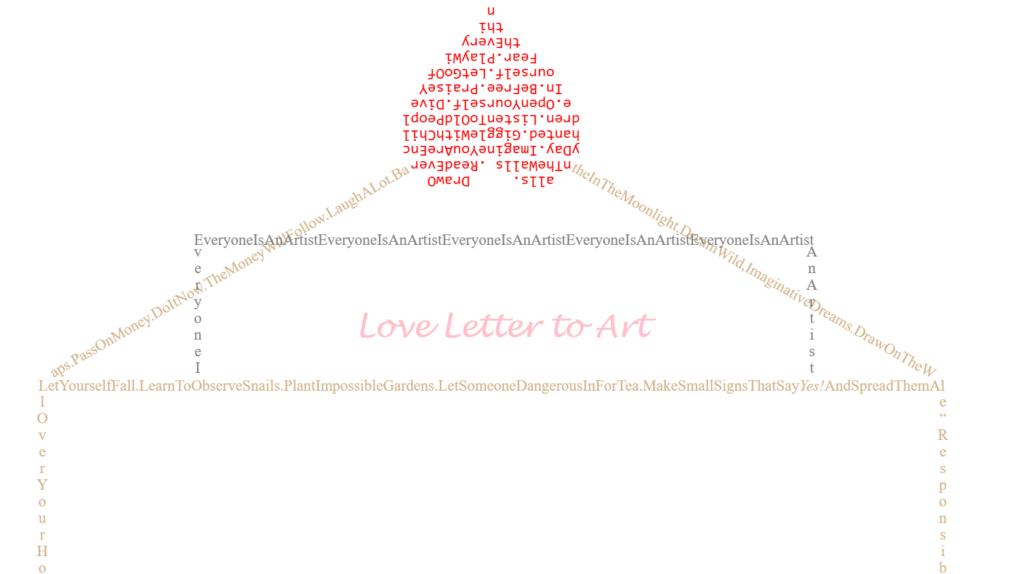
This project is a concrete poem created for a creative coding class. A quote from “Everyone Is An Artist” by Susan Ariel Rainbow Kennedy is used to make a love letter to art and every artist out there.
Visit this project online here!
The Thoughts Behind “Love Letter to Art”
I love concrete poems, and this concrete poem in particular is a way to show that love. I am both a writer and an artist, so concrete poems act as a great way for me to be creative in both of those ways. When I found “Everyone Is An Artist,” I knew I had to make that my concrete poem. As Gen AI like Chat GPT rises, many arguments for it are that it makes art accessible. As an artist, writer, and disabled person, that is absolute rubbish. Anyone can make art. Art does not have to be conventionally “good” to be art, which is an assumption that these GenAI people seem to have. All of that is to say, I resonated with the text very much, and I wanted both forms of my art to reflect that. I wanted to make the three different
forms of this poem cycle through clicking, but I’m afraid that JS is not my forte, so take a look at all three css styles!
I wanted this concrete poem to be a letter to every person. You can make art no matter what. Art doesn’t have to be big and grand. Art is beautiful. This is my love letter to (human-controlled, not GenAI) art.
Credit to “Everyone Is An Artist” by Susan Ariel Rainbow Kennedy. The link is https://designmanifestos.org/sark-everyone-is-an-artist/
“A Fairy Tale”
This project is a randomly generated fairy tale (ad-libs style) created for a coding class. Make your own trope-filled fairy tale by adding randomly chosen words to a template!
Visit this project online here!
The Thoughts Behind “A Fairy Tale”
Fairy tales are very important to me, and I like them quite a bit. I have studied them through literary studies as well as studying how they act as narratives. Both of these facts are why I wanted to create this piece based upon “The House of Dust”. Each generated text follows a generic fairy tale narrative. There are plenty of databases that show how fairy tales are similar to each other and how they create trope, such as the ATU; this project essentially pulls from my own knowledge of those tropes to create a “unique” fairy tale.
This project really interested me because it shows how oral storytelling and folk tales aren’t unique. The reason they exist is because they are common stories that people can relate to, and that is really cool. Because fairy tales aren’t unique, this generation style of writing points out that fact that many people don’t realize.
You can look more at this in “grammar.json” in my code, but I wrote a bunch of sentences with several options for verbs, adjective, nouns, and more to create the generated writing.
“Jumping in Puddles”
This project is a piece of interactive art created for a creative coding class. Release your inner child and create puddles in the water!
Visit this project online here!
The Thoughts Behind “Jumping in Puddles”
For this project, I wanted to feed my inner child and make an effect that would make puddles emerge from your rainboots when you click. I wanted it to look like it looks and feels to jump in puddles when you are a kid. I added two ripples (circle) that grow from where you click to make it look like two feet created the puddles. The difference between the two puddles was made random.
Something that I didn’t intend to make but ended up really liking was the effect where the puddle outline would flash when two puddles met. It wasn’t intentional, but it reminded me of how puddles will interact with each other, so I kept it in the code. Overall, this project did not have some grand meaning built into it, but it was something to feed the inner child within all of us.
Credit to Rainboots by luketaibai from Noun Project (CC BY 3.0) for the sprite used on your cursor.